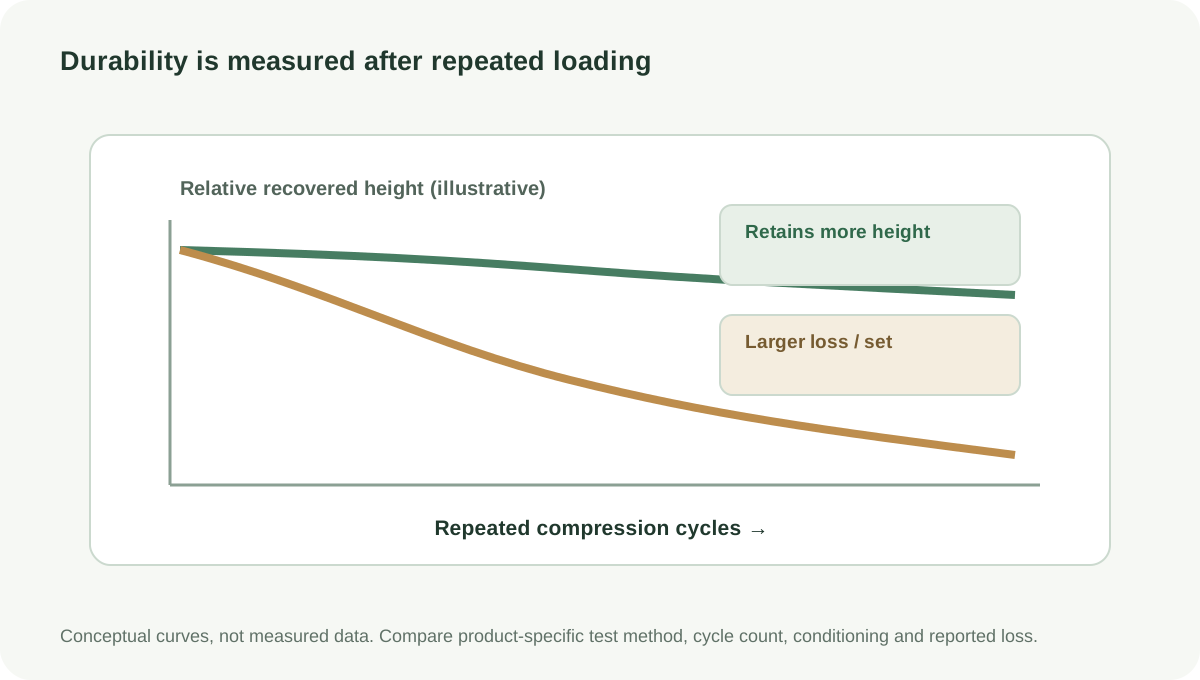
A first-day feel is not a long-term durability test. This chapter translates material-science and veterinary references into practical questions for comparing finished dog beds.
Original explanatory illustration. Any curves, shapes or contact patterns are conceptual unless explicitly described as published measurements.
Everyday analogy
A new backpack strap may feel strong once. Durability is closer to asking how it behaves after thousands of repeated pulls, not just the first tug.
What durability tests ask
Foam durability tests examine how material properties change after repeated compression, flexing, rolling or other defined stress. The PFA describes flex-fatigue procedures that compress or flex a sample for specified cycles and then measure changes such as IFD loss and height. More demanding tests can combine rolling compression and abrasion. [1]
Compression set and permanent height loss
Compression set evaluates how much a foam specimen fails to recover after a defined compression exposure and recovery period. It is different from a simple “push it with your hand” test. Test conditions, specimen dimensions, compression level, temperature, recovery period and method must be reported to compare results responsibly.
Recovery, resilience and hysteresis
Resilience describes springiness, often assessed through ball rebound. Hysteresis examines how much force behavior is recovered after loading and partial unloading. Viscoelastic memory foam generally has lower resilience than many conventional flexible foams; that is a material characteristic, not automatically a defect. [1][2]
How to judge a claim
Ask for the exact test name, standard or method, cycle count, specimen and conditioning details, percentage height loss or IFD change, and whether results are from the actual foam used in the bed. A foam coupon test does not fully measure seams, cover fit, layer bonding, floor grip or finished-product wear.
Evidence boundary
Avoid universal “lasts X years” claims without product-specific, relevant durability evidence and clearly stated use conditions. There is no reliable hand-press test that predicts a precise replacement date.
Common questions
What is compression set?
Compression set is a permanent loss of some original foam height after the sample has been compressed and released under a specified test method. It is one way to describe dimensional change; it is not the same as every form of wear or damage.
What does flex-fatigue testing show?
Flex-fatigue testing repeatedly compresses or flexes a foam sample, then measures changes such as firmness loss or height change. The result depends on the method, cycle count and test conditions, and should not be translated directly into a guaranteed number of years for a dog bed.
When should a dog bed be replaced?
There is no reliable universal replacement interval for every foam bed. Inspect for crumbling, persistent depressions, damaged seams, trapped moisture, odors that remain after proper cleaning, or a core that no longer retains its shape. Follow the manufacturer’s care and warranty terms.
These answers summarize material and product-selection information. They are not veterinary advice or a substitute for product-specific manufacturer specifications.
Research and technical references
These sources support the material-science definitions or the specific research summary above. A foam-material study is not automatically a test of every retail dog bed.