Memory Foam vs. Egg-Crate Dog Beds: What Is the Difference?
Both materials can make a dog bed more comfortable, but they feel and perform differently. Compare construction, recovery, support and care before choosing.
In this guide
Start with how the foam is built
“Memory foam” describes a viscoelastic foam that responds to heat and pressure. Egg-crate foam is cut or molded into a contoured surface with peaks and valleys. A bed may use either material alone or combine layers. The label is not enough to judge the finished mattress: the foam thickness, density, base, cover and overall construction matter too.
Memory foam: a closer, contouring feel
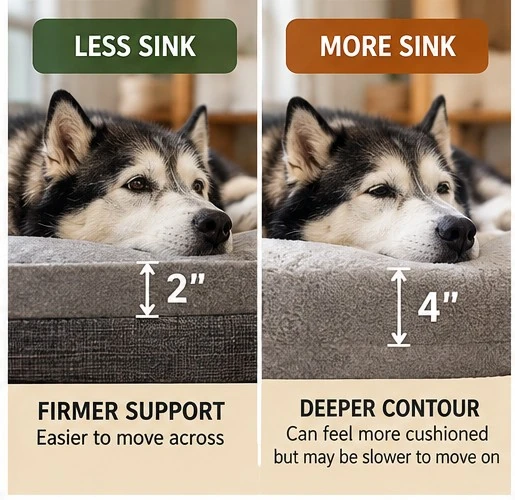
Memory foam can conform around a dog’s body under load and then recover gradually. Some dogs appear to prefer that close, cushioned feel. The response varies with foam formulation, temperature, thickness and the weight of the dog. A soft top layer does not guarantee that the bed will support a heavier dog without compressing through to the floor.
Egg-crate foam: a shaped surface
Egg-crate foam has a repeating profile that creates raised and recessed areas. The shape can make a mattress feel less uniform and may allow more space around the surface than a flat slab. It is not automatically more breathable or more supportive; those properties depend on the foam and the rest of the mattress.
Compare the practical details
| Feature | Memory foam | Egg-crate foam |
|---|---|---|
| Feel | Often contouring and slow-recovery | Often springier or more textured |
| Construction | Flat or layered foam slab | Contoured peaks and valleys |
| Support | Depends on density, thickness and base | Depends on foam quality and overall thickness |
| Care | Protect foam from moisture; follow maker instructions | Protect foam from moisture; follow maker instructions |
| Best test | Check whether it compresses through under your dog | Check whether the profile stays comfortable and stable |
Which should you choose?
Choose based on your dog’s sleeping position, body weight, ability to get on and off the bed, and preference for a flat or contoured surface. If possible, review the full dimensions and return policy. For a senior dog, entry height and stability can matter as much as the foam type.
A simple at-home fit check
Place the bed on the floor where it will normally be used. Watch whether your dog can step onto it without stumbling, turn around without sliding, lie down naturally and rise without the bed shifting. Check the underside and the surrounding floor for movement. Stop using a bed if it becomes unstable or damaged.
Compare orthopedic bed options on Chewy
After checking the foam, fit and care details in this guide, compare current bed styles and brand options. Confirm the exact foam construction, dimensions and care instructions on each product listing.
These are affiliate links routed through Creator Anchor to Chewy. We may earn a commission from qualifying purchases at no extra cost to you. Product availability and specifications can change.