Firmness, IFD and Support Factor: Three Different Questions
How soft it feels is not the same as how it supports deeper compression. This chapter translates material-science and veterinary references into practical questions for comparing finished dog beds.
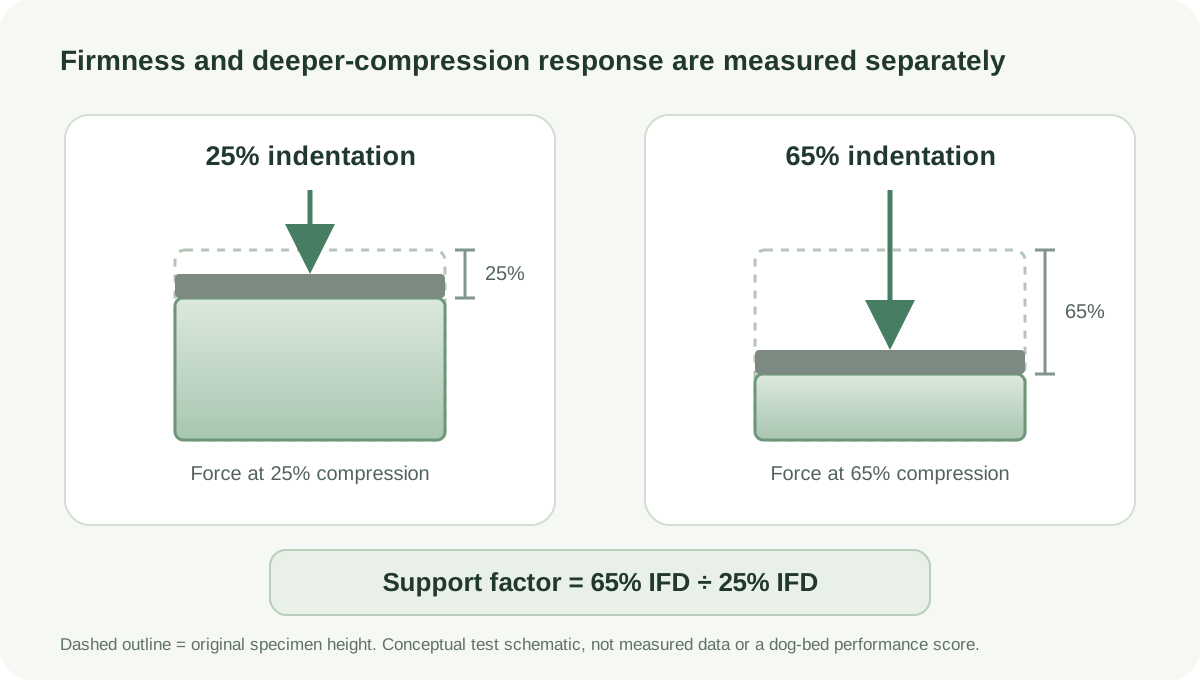
Original explanatory illustration. This is a conceptual test schematic, not measured data or a rating of any dog bed.
Everyday analogy
A sofa cushion can feel soft at first touch yet resist more strongly as it is compressed deeper. Surface feel and deeper-load response are not identical.
IFD / ILD: a defined indentation test
Indentation Force Deflection (IFD) describes the force needed to compress a foam specimen by a stated percentage under a specified test setup. A common comparison is 25% IFD. The result depends on specimen dimensions, conditioning, indentation foot and test procedure; it is not simply a person’s hand-press impression. ASTM D3574 is the principal U.S. standard family for testing flexible polyurethane foam. [1][2]
Support factor / compression modulus
The PFA describes support factor as the ratio of the force measured at 65% indentation to the force measured at 25% indentation. This helps describe how resistance changes as compression becomes deeper. A higher ratio can indicate a greater increase in resistance under deeper compression, but it is still a foam sample property—not a direct score for an assembled dog bed. [1]
Why a “soft top, stable base” design is plausible
A multi-layer design can use a softer conforming top layer with a more resilient base beneath it. The idea is to balance initial surface feel with resistance to excessive compression. Whether a specific dog bed achieves that balance depends on the actual materials, layer thicknesses, bonding, cover tension and loads.
Questions to ask
Does the maker publish IFD/ILD and the percentage indentation? Is the test method named? Are 25% and 65% values supplied so a support factor can be calculated? Do the figures apply to the exact foam used in the bed? If there are no test values, treat claims such as “extra firm,” “high support,” or “won’t bottom out” as unverified marketing language.
Evidence boundary
IFD and support factor data for foam sheets do not prove that the entire dog bed supports every dog well. They also do not establish a therapeutic effect.
Common questions
What does IFD measure?
Indentation Force Deflection measures the force required to compress a foam sample by a specified percentage under a defined test setup. A common comparison uses 25% indentation. The method, sample dimensions and conditioning matter when comparing numbers.
Is IFD the same as support factor?
No. IFD at 25% is commonly used to describe firmness. Support factor, also called compression modulus, compares deeper-compression resistance—often the 65% IFD divided by the 25% IFD. They answer different questions.
Should dog-bed brands publish IFD numbers?
Publishing test method, units, sample thickness and layer identity would make comparisons more transparent. However, a foam-sample test does not by itself prove how the assembled bed will perform under a particular dog.
These answers summarize material and product-selection information. They are not veterinary advice or a substitute for product-specific manufacturer specifications.
Research and technical references
These sources support the material-science definitions or the specific research summary above. A foam-material study is not automatically a test of every retail dog bed.
PFA — Foam Performance — Definitions of IFD, support factor, density and the bottoming-out concept.
ASTM D3574-25 — Standardized methods and the importance of stated test conditions.