Foam Density: What Pounds per Cubic Foot Actually Measure
Mass per volume—not a firmness score. This chapter translates material-science and veterinary references into practical questions for comparing finished dog beds.
Original explanatory illustration. Any curves, shapes or contact patterns are conceptual unless explicitly described as published measurements.
Everyday analogy
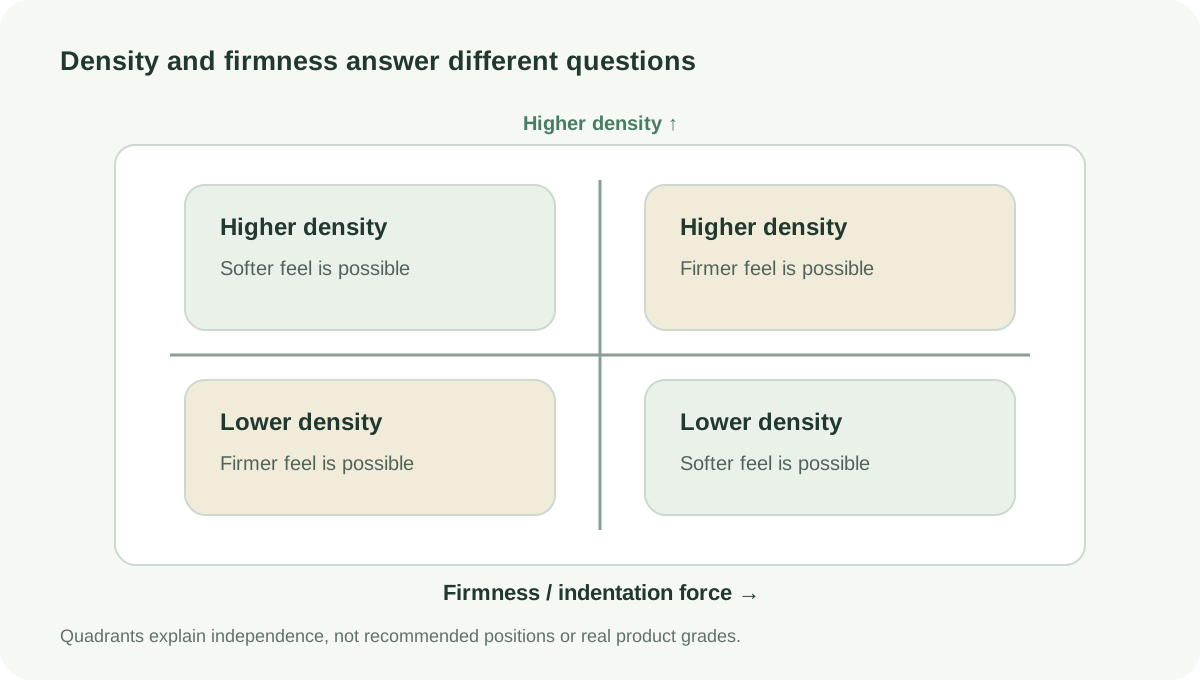
Density is like how much material is packed into a box of a fixed size. Firmness is how hard it is to press the box’s contents down. Those are different questions.
The definition
Foam density is mass divided by volume. Flexible polyurethane foam is commonly described in pounds per cubic foot (pcf) or kilograms per cubic metre (kg/m³). The PFA notes that density is affected by foam chemistry and additives, and recommends distinguishing polymer density from density that includes fillers or reinforcements when specifications are compared. [1]
Why density is not firmness
A common shopping mistake is assuming a higher-density foam must feel firmer. It does not. The PFA explicitly says firmness is independent of density: high-density foam can be soft, and lower-density foam can be firm, depending on the indentation-force specification. [1] The quadrant chart illustrates that independence.
What density can tell you
Within comparable foam families and test methods, density can be relevant to material quantity and durability potential. But it is not a stand-alone guarantee of useful life or suitability. Formulation, additives, cell structure, fatigue performance, layer design, manufacturing quality and the finished cover all matter.
How to use the number responsibly
Ask whether the manufacturer provides density for each foam layer or only an overall product description. Confirm units and whether the figure is measured polymer density. Do not compare numbers from different material families as though they were a universal ranking. When no density is published, record it as “not disclosed” rather than guessing from the bed’s weight.
Evidence boundary
There is no universal density threshold that proves a dog bed is orthopedic or appropriate for every dog. A density number alone cannot substantiate medical, comfort or lifespan claims.
Common questions
What does foam density mean?
Density is mass divided by volume. Flexible polyurethane foam is commonly specified in pounds per cubic foot (pcf) or kilograms per cubic metre (kg/m³). It describes how much material occupies a given volume, not how firm the surface feels.
Does higher density automatically mean firmer foam?
No. The Polyurethane Foam Association explains that firmness and density are separate properties. A foam can be relatively dense yet feel soft, or less dense yet feel firm, depending on its formulation and indentation-force specification.
Can I estimate density by lifting a dog bed?
Not reliably. A finished bed’s total weight includes fabric, bolsters, liners, zippers and multiple foam layers. Ask the manufacturer for the density of each foam layer, its units, and whether the figure is polymer density or includes fillers.
These answers summarize material and product-selection information. They are not veterinary advice or a substitute for product-specific manufacturer specifications.
Research and technical references
These sources support the material-science definitions or the specific research summary above. A foam-material study is not automatically a test of every retail dog bed.
PFA — Foam Performance — Density is mass per volume; the page distinguishes density from IFD firmness.
ASTM D3574-25 — Standard test methods for flexible cellular polyurethane foam, including density and mechanical properties.