What Memory Foam Is: Viscoelasticity and Slow Recovery
The material science behind the “memory” effect. This chapter translates material-science and veterinary references into practical questions for comparing finished dog beds.
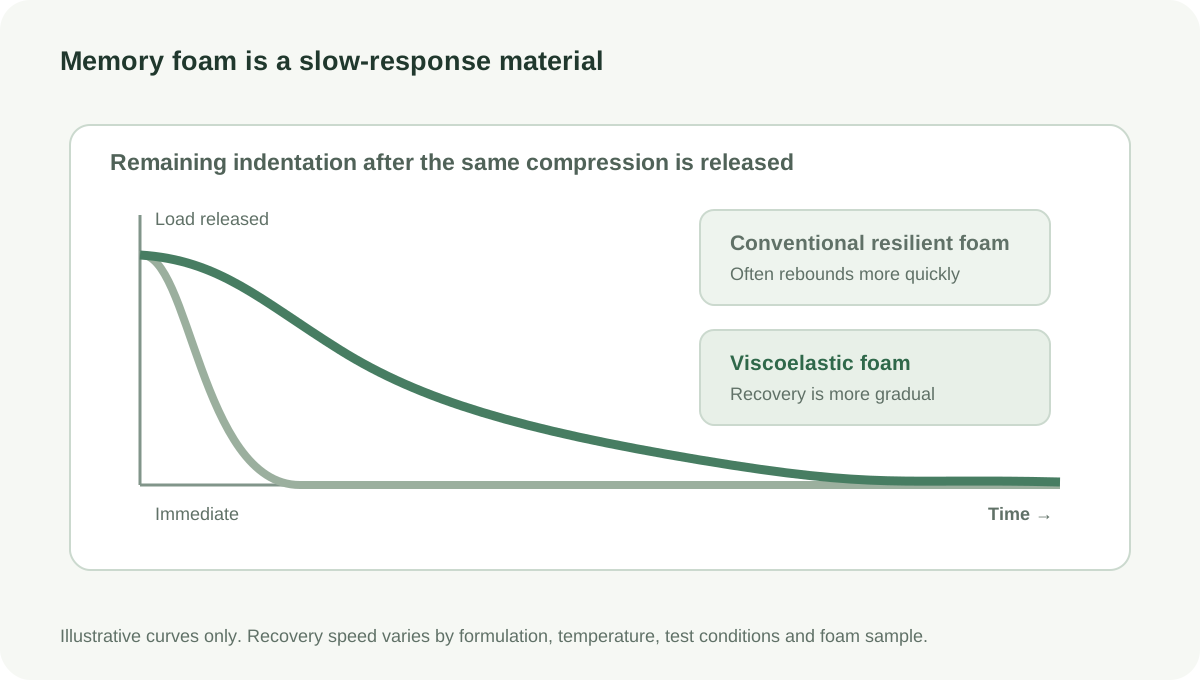
Original explanatory illustration. Any curves, shapes or contact patterns are conceptual unless explicitly described as published measurements.
Everyday analogy
Think of two seat cushions after someone stands up: one springs back quickly; the other eases back gradually. The slower response is the “memory” behavior—not a sign by itself of higher quality.
What the material name means
Memory foam is commonly a viscoelastic form of flexible polyurethane foam. “Viscoelastic” describes a material that combines elastic behavior (it can recover) with time-dependent, viscous behavior (its response changes with time). Under a sustained load it gradually conforms; after the load is removed it recovers more slowly than many conventional resilient foams. The Polyurethane Foam Association (PFA) describes memory foam as slow-recovery foam and notes that many formulations also respond to body and ambient temperature. [1][2]
Why slow recovery matters—and what it does not tell you
Slow recovery describes how the foam responds to a particular compression and test condition. It does not independently tell you the foam density, indentation firmness, support factor, thickness, durability, or how a finished dog bed will perform under a particular dog. Those are separate variables. The same “memory foam” label can cover different formulations and construction choices.
A useful comparison
The spring-and-damper analogy is helpful: a simple spring stores energy and rebounds; a damper resists fast movement and releases energy over time. Viscoelastic foam combines time-dependent response with elastic recovery. This is a teaching analogy, not a complete molecular model.
What to ask before buying
Ask for the actual layer description, thickness, density if available, and any standardized firmness or fatigue test data. Ask whether the quoted specification applies to the comfort layer, support core, or the entire mattress. A brand name or “memory” label is not a complete material specification.
Evidence boundary
No dog-specific clinical conclusion follows from a material being viscoelastic. Do not translate “slow recovery” into a claim that it treats arthritis, reduces pain, or prevents injury.
Common questions
Is memory foam different from ordinary polyurethane foam?
Memory foam is generally a viscoelastic type of flexible polyurethane foam. It tends to recover more slowly after compression than many conventional resilient polyurethane foams. The label alone does not specify density, firmness, layer thickness or finished-bed performance.
Does slow recovery mean a foam is better?
No. Slow recovery describes one material response. Whether it suits a particular dog depends on the complete mattress construction, the dog’s size and resting style, and the dog’s observed comfort. Ask for separate density, firmness and layer details.
Can temperature change how memory foam feels?
Yes. Viscoelastic formulations can be temperature-sensitive, so the same foam may feel different in cooler and warmer conditions. The effect varies by formulation and test conditions; a marketing label cannot predict the exact feel in a home.
These answers summarize material and product-selection information. They are not veterinary advice or a substitute for product-specific manufacturer specifications.
Research and technical references
These sources support the material-science definitions or the specific research summary above. A foam-material study is not automatically a test of every retail dog bed.