Pressure Distribution: What the Dog-Specific Evidence Shows
A useful research area—but not proof that a retail bed treats a condition. This chapter translates material-science and veterinary references into practical questions for comparing finished dog beds.
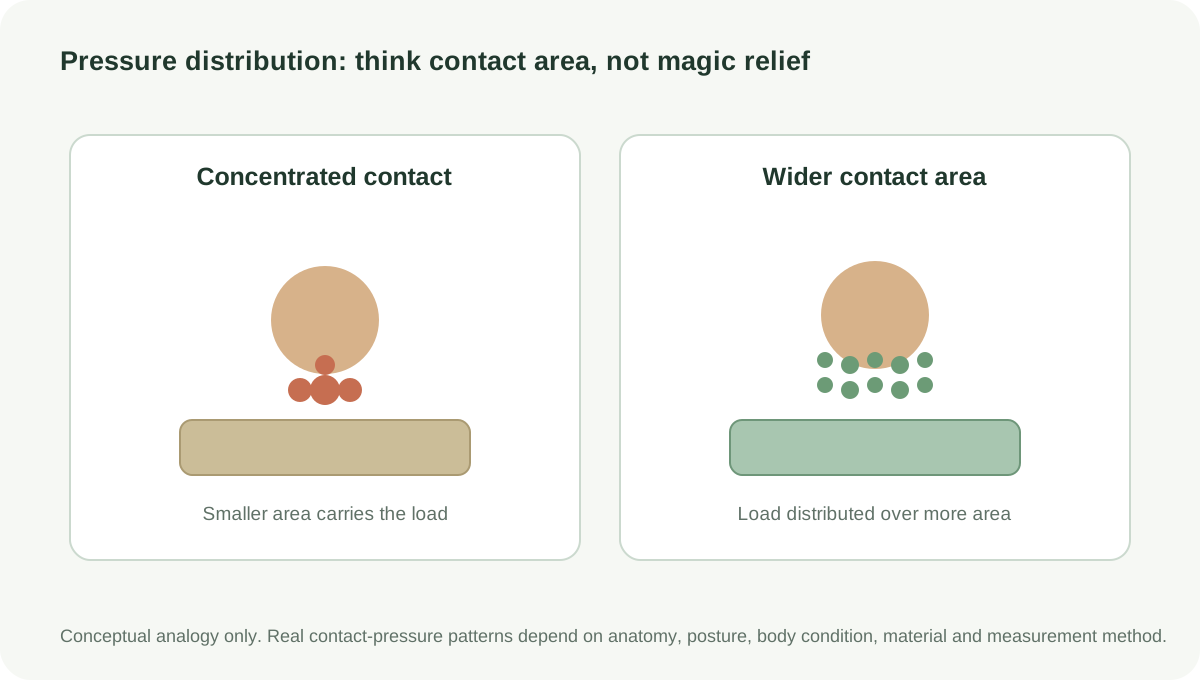
Original explanatory illustration. Any curves, shapes or contact patterns are conceptual unless explicitly described as published measurements.
Everyday analogy
A pointed heel concentrates force over a small footprint; a wider sole spreads the same load across more area. The analogy helps explain contact pressure, but a dog’s anatomy and posture make the real pattern more complex.
What pressure mapping measures
A pressure mat estimates contact pressure at the interface between a body and a support surface. The image can reveal areas where load is concentrated. It does not by itself measure pain, comfort preference, sleep quality, long-term mobility or disease outcomes.
A dog-specific study worth knowing
Caraty and colleagues compared blankets on the floor, a standard mattress, a veterinary memory-foam mattress and a human-medicine memory-foam mattress. The study used three cadaver dogs positioned on their sides and measured interface pressure for four hours. It reported lower pressures in recurrent risk zones on pressure-relieving mats than on the standard mattress or blanket. [1]
Why the limitation matters
The study involved only three cadaver dogs, not a clinical trial in living household pets. It also reported that static pressure-relieving mats were generally insufficient to maintain the stated safe pressure threshold in the risk zones, particularly for thin dogs; the authors recommended frequent repositioning. [1] The result supports careful interest in pressure mapping, not a blanket claim that every memory-foam dog bed prevents sores.
How to translate this into buying questions
Look for independent pressure-mapping evidence on the actual finished product, if a brand makes a pressure claim. Ask what surface, dog population, posture, duration, pressure sensors and comparator were used. Distinguish “pressure was measured” from “a clinical health benefit was demonstrated.”
Evidence boundary
The available study is small and cadaver-based. It does not prove that consumer memory-foam beds treat arthritis, relieve pain, prevent pressure injuries in ordinary home use or improve long-term outcomes.
Common questions
Does research prove memory foam dog beds relieve arthritis pain?
No. The dog-specific study summarized here measured pressure on several support surfaces in three cadaver dogs. It did not test living dogs’ pain, mobility, arthritis outcomes or the long-term performance of retail beds.
What does pressure mapping measure?
A pressure mat records the distribution and magnitude of contact pressure between a body and a support surface under the study conditions. Results can help compare surfaces, but they do not directly measure comfort, pain or clinical improvement.
Why does the study sample size matter?
The study involved three cadaver dogs of similar size and a limited set of support surfaces. That is useful preliminary evidence about measured contact pressure, but it cannot establish a universal rule for all dogs, all memory foams or all commercial mattresses.
These answers summarize material and product-selection information. They are not veterinary advice or a substitute for product-specific manufacturer specifications.
Research and technical references
These sources support the material-science definitions or the specific research summary above. A foam-material study is not automatically a test of every retail dog bed.