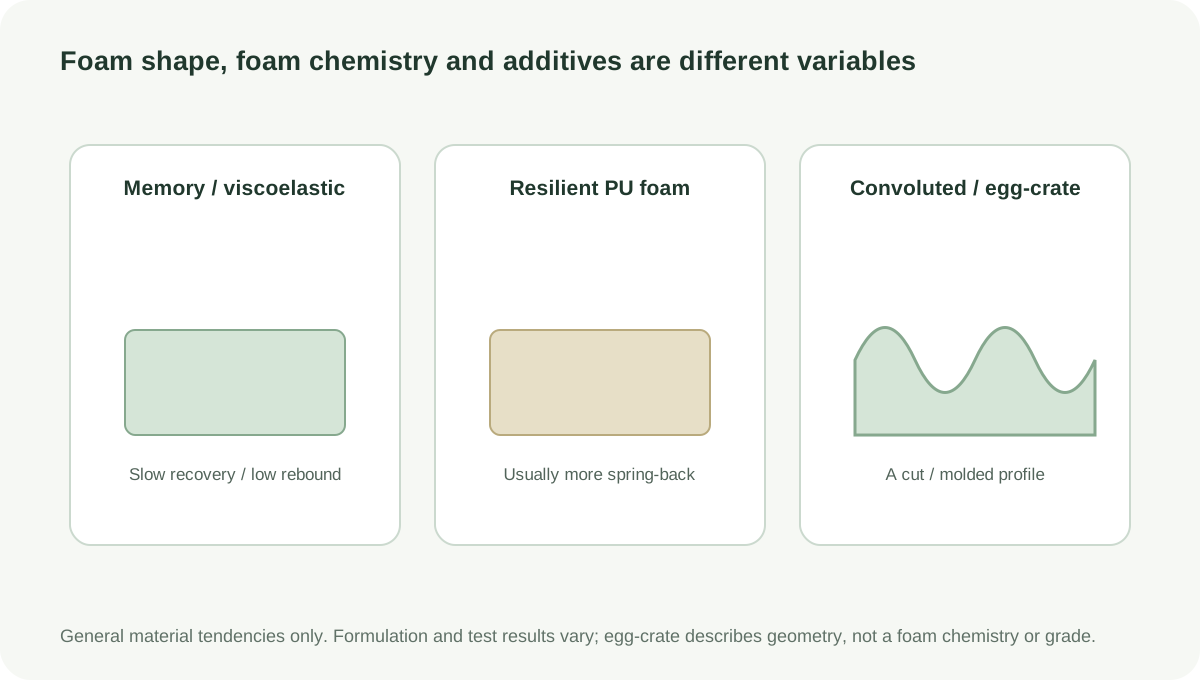
Foam Types and Profiles: Memory, Resilient PU, Egg-Crate and Gel
Separate material chemistry from the shape cut into it and from additives. This chapter translates material-science and veterinary references into practical questions for comparing finished dog beds.
Original explanatory illustration. Any curves, shapes or contact patterns are conceptual unless explicitly described as published measurements.
Everyday analogy
“Memory foam” is like the recipe; “egg-crate” is like the shape cut into the finished loaf. One describes material behavior, the other describes geometry.
Memory foam
Viscoelastic polyurethane is characterized by slower recovery and low resilience relative to many other flexible polyurethane foams. PFA also notes its tendency to conform gradually and that many viscoelastic products respond to heat. [1][2]
Conventional or resilient polyurethane
Flexible polyurethane is a broad family whose properties can be formulated across a range. Some grades are designed for more resilient, spring-back behavior; the actual feel and performance depend on density, IFD, support factor, cell structure and fatigue characteristics. Do not treat all non-memory foam as one grade.
Egg-crate / convoluted profile
Egg-crate generally describes a convoluted surface geometry made by cutting or molding peaks and valleys into foam. It does not identify the chemistry, density, firmness or durability. An egg-crate profile may be made from different foam grades. The profile can alter local contact and surface ventilation, but cannot be ranked universally without test data.
Gel and other additives
“Gel-infused,” graphite, copper or other additive labels describe a modification or marketing category, not a complete performance specification. Ask what the additive is, how much is used, which layer contains it and what independent test demonstrates the advertised benefit. Prefer side-by-side finished-product data over ingredient-name assumptions.
Evidence boundary
No foam family or profile is automatically “best.” Products vary within each category, and a profile image cannot establish density, support factor, heat performance or service life.
Common questions
Is egg-crate foam a different chemical from memory foam?
Usually, “egg-crate” describes a convoluted surface profile—peaks and valleys—rather than a single chemical formulation. It may be cut from different flexible foam types. Ask what the underlying foam material is, not just what profile it has.
Does a gel layer prove a bed is cooling?
No. A gel label does not establish a measured temperature benefit. Look for a defined test comparing the finished bed under consistent conditions, and consider the cover and airflow as well as the foam additive.
Can a dog bed combine memory foam and conventional polyurethane foam?
Yes. A mattress may combine a conforming comfort layer with a more resilient support layer or base. The important questions are what each layer is made of, its dimensions and specifications, and how the assembled product behaves under load.
These answers summarize material and product-selection information. They are not veterinary advice or a substitute for product-specific manufacturer specifications.
Research and technical references
These sources support the material-science definitions or the specific research summary above. A foam-material study is not automatically a test of every retail dog bed.