Airflow and Temperature: What “Cooling” Foam Claims Need to Show
The cover, foam structure, bed build and room all contribute. This chapter translates material-science and veterinary references into practical questions for comparing finished dog beds.
Original explanatory illustration. Any curves, shapes or contact patterns are conceptual unless explicitly described as published measurements.
Everyday analogy
A breathable jacket needs both fabric that lets air move and a design that does not trap all the openings underneath another sealed layer. The foam and the cover work as a system.
Airflow is measurable
The PFA describes airflow as a diagnostic test for flexible polyurethane foam and notes that it can indicate whether cells are open and flexible. The PFA’s cited rule of thumb applies to flexible polyurethane foam grades and should not be converted into a dog-bed pass/fail threshold without the relevant product test and context. [1]
Why cover and construction matter
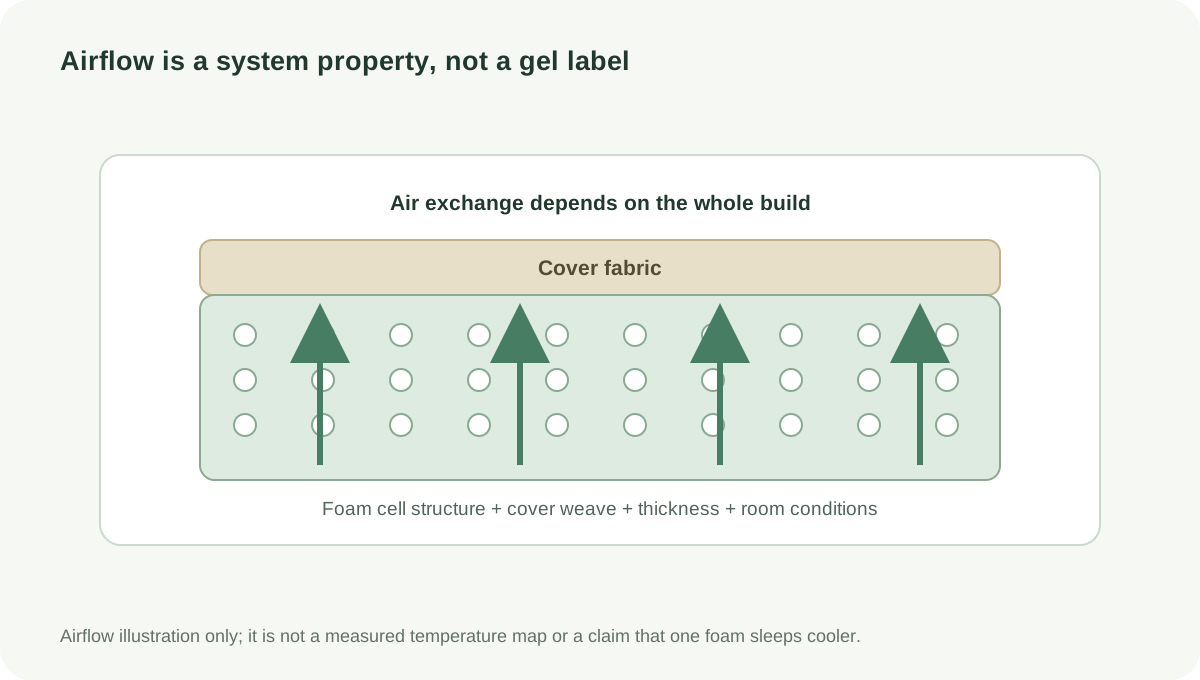
A breathable foam can be covered by a tightly woven, quilted or waterproof layer that changes air exchange at the surface. Mattress thickness, base material, contact area, room temperature, bedding layers and the dog’s coat and resting habits also affect perceived warmth. Foam-cell airflow is one variable, not a complete sleep-temperature measurement.
Gel, graphite, copper and “ice” labels
Infusions and special cover materials may change material behavior, but the name alone does not quantify a finished bed’s thermal performance. Ask for comparative test results on the assembled product, including test setup, ambient conditions, contact load, cover configuration and duration. A blue graphic, gel bead or “cooling” label is not a temperature test.
How to compare claims
Look for a clear explanation of what was tested: foam airflow, thermal conductivity, surface temperature, heat-flux response or a controlled comparison of finished beds. These are not interchangeable measurements. If results are not disclosed, describe the feature as a design claim rather than a proven cooling outcome.
Evidence boundary
This site does not claim that memory foam inherently sleeps hot or that gel automatically makes a dog bed cooler. Comparative thermal conclusions require comparable testing of the product as sold.
Common questions
Does gel-infused memory foam automatically sleep cooler?
No. Gel is an additive or construction feature, not a guaranteed temperature result. Cooling performance depends on the formulation, amount and distribution of gel, foam structure, cover fabric, airflow and test conditions. Look for comparative temperature data if a maker makes a measurable cooling claim.
Is open-cell foam always cooler than closed-cell foam?
Not automatically. Cell openness can affect airflow and moisture movement, but the assembled bed also includes cover fabric, liners, thickness and the surface beneath it. Do not infer a specific sleeping temperature from “open-cell” alone.
Why can memory foam feel different in different rooms?
Viscoelastic foam can respond to temperature. A cooler environment may make some formulations feel firmer or slower to respond, while warmer conditions may change their feel. The size of the effect is product-specific.
These answers summarize material and product-selection information. They are not veterinary advice or a substitute for product-specific manufacturer specifications.
Research and technical references
These sources support the material-science definitions or the specific research summary above. A foam-material study is not automatically a test of every retail dog bed.